
As Canada becomes increasingly multicultural, understanding how newcomers integrate and participate in their new communities is more important than ever. To explore this topic, the Newcomer Knowledge Hub (K-Hub) hosted a Lunch & Learn session featuring experts from the Metropolis Institute: Paul Holley, Director of Research and Evaluation; Ravinder Shrestha, Senior Data Analyst; and Michelle Vital, Research Associate. During the session, they shared the latest updates on the Canadian Index for Measuring Integration and Inclusion (CIMII), a framework for tracking newcomer outcomes nationwide.
What is CIMII?
Michelle Vital introduced the CIMII as a data-driven tool designed to assess immigrant integration in Canada for individuals aged 18 to 64. The Index compares outcomes between immigrants and the Canadian-born population, as well as between established immigrants (5+ years in Canada) and recent immigrants (less than 5 years in Canada), focusing on permanent residents.
Drawing from data between 1991 and 2021, CIMII analyzes patterns across all ten provinces and 41 Census Metropolitan Areas (CMAs). Its primary data sources include the Canadian Census, the General Social Survey (GSS), and the Canadian Community Health Survey (CCHS).
Dimensions and Indicators of Integration
The CIMII measure integration through four key dimensions and 22 indicators:
- Economic (8 indicators): Employment, unemployment rates, and subsidized housing rates.
- Social (6 indicators): Social connections and sense of belonging to community or province.
- Civic and Democratic Participation (4 indicators): Involvement in community organizations and participation in democratic processes.
- Health (4 indicators): Access to healthcare, for instance, having a regular medical doctor and satisfaction with life.
Each province and CMA receives a ranking based on the size of the gap between immigrant and Canadian-born outcomes. Smaller gaps indicate stronger integration performance. Rankings are produced at the indicator, dimension, and overall levels, weighted as follows: Economic (40%), Social (30%), Civic (20%), and Health (10%).
What Makes CIMII
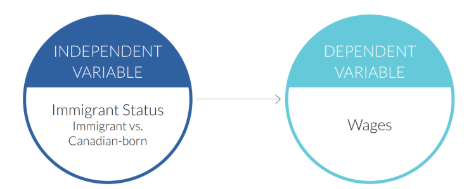

Unlike simple descriptive measures to explore basic relationships between two variables (left object), CIMII uses a statistical regression model that controls variables such as age, gender, and income. This approach ensures fairer, more accurate comparison of immigrant integration outcomes across regions (right object).
Each indicator includes three key variables:
A= Immigration status (immigrant or Canadian-born)
B= Geography (province or CMA)
A*B= The interaction between immigration status and geography, which determines each region’s CIMII ranking.
Why CIMII Matters?
According to Paul Holley, CIMII is more than a measurement tool; it supports action at multiple levels:
- For service providers: It highlights local needs, supports program development, and helps secure funding.
- For researchers: It offers insights into both current and historical immigrant experiences in Canada.
- For policymakers: It informs decisions and promotes equitable polices design.
- For communities: It fosters dialogue and strengthens advocacy through reliable, evidence-based data.
CIMII Website Walkthrough
Ravinder Shrestha demonstrated the CIMII website, where users can explore and interact with its data tools and resources. A new feature, the CIMII City Profile, has launched a pilot project with the City of Calgary. This profile compiles all CIMII dimensions and indicators into a single, accessible document, offering a snapshot of local integration performance and areas for improvement.
The CIMII platform also offers free e-learning modules, featuring interviews with subject matter experts who explain each integration dimension (economic, social, civic, or health) and how the indicators can be used effectively.
Integration vs. Inclusion
Vital explained that integration measures how immigrants participate in society compared to Canadian-born populations. As Berry (2011)i noted, integration is a two-way process; immigrants adapt to the society while institutions evolve to meet newcomers’ needs.
Inclusion, by contrast, reflects the environment that enables participation. It involves factors such as fair hiring, access to services, representation, and public attitudes toward racism and discrimination. CIMII applies an intersectional approach, examining outcomes by gender, ethnicity, age, and other characteristics to ensure a more nuanced picture of inclusion.
Expanding CIMII: Northern and Francophone Contexts
Holley shared updates on expanding CIMII through NISHI Project (Nunavut Inuit Sustainable Housing Index). This initiative applies CIMII indicators to housing and well-being in regions with smaller immigrant populations, such as Yellowknife, Whitehorse, and Iqaluit.
CIMII is also deepening its focus on Francophone immigrant integration in non-Francophone communities, analyzing economic and social outcomes. For instance, between 2011 and 2021, Francophone immigrants in Vancouver reported an employment rate of 85.3%, with an unemployment rate of 6.2%.
Looking Ahead
The CIMII team is exploring ways to collect more timely and locally relevant data between Census cycles by partnering with IRCC and settlement organizations. Future plans include publishing policy insights and documenting success stories to showcase best practices that can be replicated across Canada.
CIMII continues to evolve as a vital national resource, bridging data, policy, and practice to strengthen newcomer integration and inclusion.
The Lunch & Learn series is a monthly virtual gathering hosted by the Newcomer Knowledge Hub. We provide informative presentations delivered by experts in the settlement sector. Whether you are a service provider, policymaker, student, or simply curious about the world of settlement, we invite you to join us at our next session by registering here.
Leave a Reply